
Public programme brief
NWPharmaTech CHR-P initiative
Version 2026-09-22 · Informational overview for visitors, collaborators and press. Not an offering document. Not medical advice.
1. Mission
Intervene earlier in the psychosis pathway — supporting rigorous research aimed at people at clinical high risk — while keeping pharmaceutical-sponsor accountability and clear evidence standards.
2. The need
CHR-P identifies elevated transition risk; it is not a schizophrenia diagnosis and does not mean transition is inevitable. There is still no broadly approved pharmacotherapy labelled to prevent psychosis in CHR-P across major markets.
3. Investigational programme
NWPT-SM32300 is NWPharmaTech’s investigational 300 mg CBD micellar-emulsion softgel for people experiencing symptoms associated with a clinical high risk of psychosis.
The programme is led by Professor Scott Woods as CHR-P programme lead in an individual scientific capacity. See Team for affiliation notes (Yale University does not sponsor or endorse this website).
The planned Phase 2B study is designed to evaluate dose response, symptoms, safety and tolerability, and inform the next stage of development. The proposed design includes approximately 328 participants receiving placebo or one of three daily doses over 12 weeks, with follow-up at week 16.
Effectiveness in this population has not been established. Prevention or delay of transition to psychosis is a longer-term question that must be separately powered if claimed as primary. Primary outcome details are being finalised.
4. Evidence status (summary)
- Field CHR-P literature: elevated, heterogeneous risk — cited on the evidence library.
- Other CBD products: hypothesis-generating only — not NWPT-SM32300 efficacy.
- Programme-specific efficacy / prevention: not established.
- Numerical exposure and safety figures: not published here until formal study reports are available.
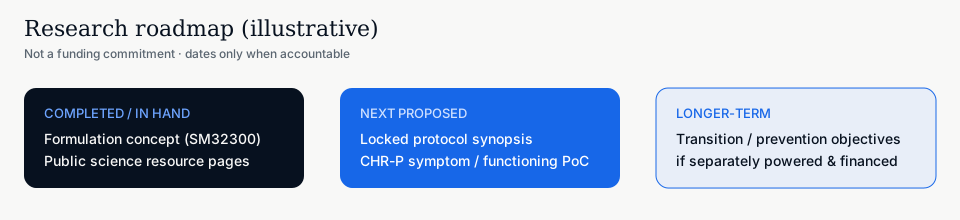
5. Research roadmap
Qualitative horizons only (no invented progress percentages). See the programme roadmap for communication milestones versus clinical development milestones.
- Communications (completed where true): public science resources; programme synopsis / Phase 2B overview; investigational formulation described.
- Clinical (Phase 2B): study preparation in progress; applicable approvals not confirmed in public materials; site activation, recruitment, follow-up and analysis planned.
6. Governance
NWPharmaTech remains pharmaceutical sponsor. Investigators, ethics committees and regulators retain independent roles. Community or financing participants do not vote on protocol, dose, endpoints, safety or regulatory submissions.
7. Financing note
Any financing discussion remains planning-only and inactive on this public site. This page is not an offer and does not accept investments. See funding use for labelled planning context if needed.
8. Contact
Press and general enquiries: team@nwpharmatech.com. Do not send clinical or personal health information by email.
Selected field references
- Fusar-Poli P, et al. Meta-analyses of transition risk in clinical high-risk samples (see evidence library).
- Yung AR, McGorry PD, et al. Ultra-high-risk / CAARMS criteria literature.
- Cannon TD, et al. NAPLS enrichment / risk prediction research.
- McGuire P, et al. Am J Psychiatry 2018 — adjunctive CBD in schizophrenia (other product / population).
Full citations and links: Evidence library. Confidential investor diligence materials are not published on this page.
Further reading: Public synopsis · Funding use · Programme · Contact